
Low-tech Asbestos Systems: Why Having The Register Is No Longer The Hard Part
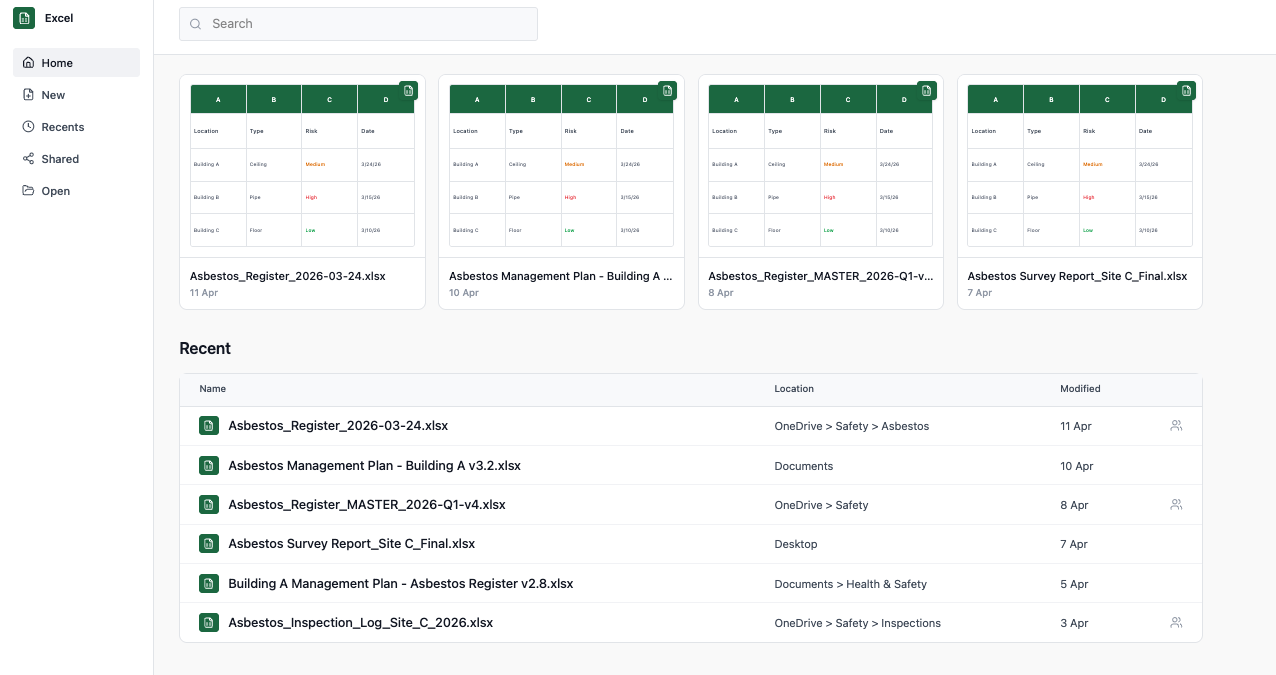
Having an asbestos register is no longer enough. As regulatory expectations shift from documentation to demonstrable control, large asset portfolios are moving from low-tech systems to purpose-built platforms. See what that looks like in practice.
In January 2026, SafeWork NSW publicly registered an Enforceable Undertaking that named "low-tech systems" as a root cause of asbestos management gaps across a large state government asset portfolio.
Many organisations still manage asbestos risk using spreadsheets, shared drives, and email threads because those systems have traditionally done the job. However, these systems weren't built for this purpose, and as portfolios grow and regulatory expectations increase, the cracks start to show.
For the people responsible for health and safety, information systems, and compliance at large organisations, that finding will be familiar. Not because they've been through an enforcement action, but because the systems being described are the same ones most large portfolios are still running on. The real question isn't about one organisation, it's what happens when any large, complex portfolio is asked to prove its asbestos management under scrutiny, and what its current systems can actually produce.
What is the problem with low-tech systems for asbestos management?
No single source of truth
Registers, inspection reports, contractor records and asset documentation are stored across multiple locations. This creates duplication and makes it systematically impossible to maintain a single source of truth. When information is updated at one site, that change doesn't always reach the people who need to know about it.
Information that lags behind reality
Manual update processes create a gap between when information changes and when it is updated in the record. Contractors and maintenance teams may unknowingly rely on documentation that was accurate twelve months ago and not accurate today. The gap between information changing and critical safety information reaching the people who need it becomes both a safety and compliance risk.
No visibility over contractor access
There is often no traceable record to confirm that a contractor has accessed the correct, site-specific asbestos information before work begins. Across a large portfolio with hundreds or thousands of contractors working across sites, this is where low-tech systems break down. The access may have happened, but it cannot be proven, or there is no confidence that the version accessed was the correct one.
Inconsistent risk decisions
Low-tech systems can recommend a risk framework but cannot enforce one. Without a platform that standardises assessment in the field, risk decisions vary between teams, contractors, and locations. What gets flagged at one site may be managed differently at another. Decisions become difficult to justify, compare, or defend, and a reliable portfolio-wide view of risk becomes impossible to build.
Gaps in audits
When a regulator or internal stakeholder asks to see what happened, who updated a record, when a decision was made, whether a contractor accessed the register before work began, the answer with low-tech systems often has to be pieced together manually. In many cases, the evidence doesn't exist in a form that can be produced when required.
Individually, these problems may feel manageable. Across a large, dispersed portfolio they don't stay that way.
What regulators are now looking for
Regulatory expectations in asbestos management have shifted from just having documentation to also being able to demonstrate control.
A 2024 compliance campaign conducted by Workplace Health and Safety Queensland audited 182 workplaces across the state specifically focused on asbestos management. The most common failures found weren't only about missing registers, they also included a lack of review processes for existing registers, insufficient training and information provided to workers, and limited access to the asbestos register.
That last finding is worth noting. The register existed. It just couldn't be reached, shared, or verified in the moment it was needed.
This is the gap low-tech systems create, and the gap regulators are now closing in on. The recent Enforceable Undertaking registered by SafeWork NSW demonstrates an increasing expectation to show that:
- Asbestos information is accurate, current, and centrally accessible
- Data is available to the right people, including contractors and at the right time
- Contractors understand site-specific risks before work begins, with a traceable record of access
- Risk is assessed consistently across all assets using a structured framework
- A complete audit trail exists for all updates, decisions, and contractor interactions
Going digital does not mean the problem is solved
Most organisations that recognise the limits of their current systems do the same thing: they move the problem into a digital format. Spreadsheets become cloud spreadsheets. Paper forms become PDFs. Shared drives become SharePoint. It is progress, but the underlying system hasn't changed, only the medium has.
From a compliance standpoint, a contractor opening a SharePoint folder is not meaningfully different from opening a filing cabinet. There is still no guarantee the information is current. There is still no traceable record that they accessed it. The compliance gap remains, it's just harder to see now because it looks digital.
Others go further and attempt to build something themselves. The intention is right, but a custom-built platform is a significant undertaking and often inherits the same structural limitations as the system it was designed to replace.
The more direct path is a purpose-built asbestos management platform designed to manage risk at scale. In practice, the difference usually comes down to three things:
Centralise asbestos data and information
All registers, surveys, inspections, and contractor records held in one platform. A live, single source of truth, updated in real-time and accessible to authorised users from anywhere, with every change automatically logged and a complete audit trail as standard.
Integrate and streamline contractor management
Contractors access the correct, current asbestos information before work begins, via QR code or direct link, with no login required. Every access is timestamped, attributed to a named individual, and logged automatically.
Enable asbestos risk profiling
Octfolio applies structured risk frameworks aligned to national guidance, including the National Guide for Asbestos Surveys risk profiling algorithm, consistently across entire portfolios. Live dashboards surface high-risk assets automatically, supporting proactive planning, accurate budgeting, and long-term risk reduction.
The distinction is not between old technology and new technology. It is between a system that can demonstrate compliance under scrutiny, and one that cannot.
The proof that transformation is possible at scale
This shift is already happening. The organisations moving first are doing so because the direction of regulatory expectations is clear, and a proactive response is always more manageable than a reactive one.
Tasmania's Department for Education, Children and Young People (DECYP) shows what this transition looks like at government scale. Starting from fragmented, site-by-site hard-copy registers and inconsistent contractor practices across a large statewide portfolio, they moved to a single centralised platform.
After implementing Octfolio:
- School enquiries were resolved in minutes, not days, with facilities teams accessing the same up-to-date register as schools and contractors
- Contractor access became traceable and auditable, with a defensible record for every site interaction
- Earlier risk identification supported better capital planning and reduced unexpected findings
- Central and site-based teams worked from the same information for the first time
Read the full Tasmania DECYP case study →
Most of the time, low-tech systems feel like they're working. It's only when you need to prove something that you find out they weren't.
About Octfolio
Octfolio is a purpose-built asbestos and HAZMAT management platform trusted by government and enterprise organisations across Australia and New Zealand, managing more than 145,000 assets and 1.7 million compliance records across government and enterprise portfolios.
One of our customers who is a Senior Asset Analyst at a State Government Department described the impact of Octfolio as:
”The vast improvement in data and greater accessibility to information as a result of the Octfolio register has translated to a reduction in incidents of potential exposure to ACMs.”
Ready to move beyond low-tech systems?
Book a demo to see how Octfolio can help your organisation demonstrate control across your entire asset portfolio.
Written by
