
Asbestos Management Costs: Budget Forecasting With Asbestos Management Software
Turn asbestos register data into clear forecasts of upcoming inspections, audits and removals, and budget with confidence across your portfolio.
Without reliable portfolio data, budgets become educated guesses rather than evidence-based forecasts. For PCBUs and asset owners managing large, dispersed portfolios, that gap shows up as higher costs, greater risk exposure, and funding decisions made without the evidence to back them. Octfolio is asbestos management software that presents asbestos register data in a way teams can use to forecast upcoming compliance work and budget with confidence.
Under work health and safety laws, organisations with asbestos-containing materials (ACMs) on their premises are required to maintain an asbestos register, develop and implement an asbestos management plan, and ensure materials are re-inspected on a defined schedule. That’s not a one-off cost, it’s an ongoing, multi-year obligation, and one that’s hard to plan for without complete visibility of what work is coming up or outstanding across the portfolio.
Octfolio was built to close the compliance gap left by traditional, low-tech systems. However, in customer conversations and demos, we’ve increasingly heard teams highlight the budgeting value, especially when it comes to forecasting asbestos survey costs, asbestos inspection costs, and asbestos removal costs across many sites.
The problem: budgeting on incomplete information
Every organisation with ACMs and an asbestos management plan has to budget for it. This includes removal programs, re-inspections, remediation and additional costs for contractors, particularly when planning projects. However, budgeting requires a number, and a number requires confidence in the data you have on what you are managing.
If information is fragmented across spreadsheets, paper files, desktop files and contractor emails, building that number involves assumptions. This means teams can’t instantly answer the workload questions a budget cycle depends on:
- Which assets are approaching re-inspection or re-audit
- Which materials are deteriorating and moving up the risk scale
- Where the next removal program should be prioritised based on risk
- How much of the portfolio is un-assessed, and therefore an unknown liability
The last point is the hardest to budget around. An asset that hasn’t been surveyed or risk-rated isn’t a data gap you can simply note and move past. It’s a cost you can’t forecast, and a liability you can’t insure against accurately.
Without a reliable answer to these questions, organisations tend to land in one of two places: over budgeting for ‘just in case’ scenarios, or under budgeting and feeling the pressure of unplanned, urgent works when a risk is discovered unexpectedly.
The solution: forecasting starts with visibility
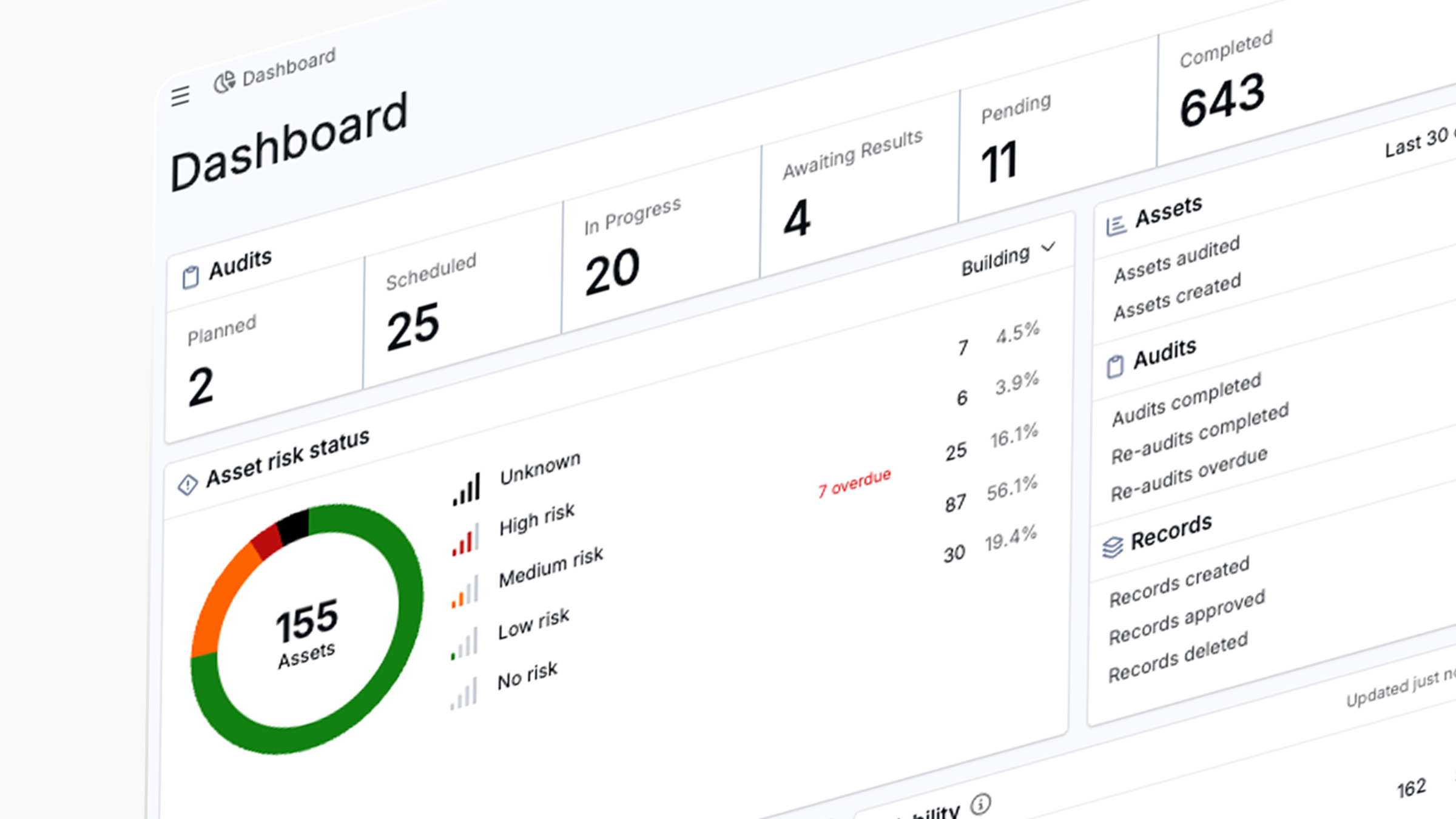
Octfolio gives teams that visibility through its various features, but specifically the Dashboard and Views.
Dashboard: your entire portfolio status, at a glance.
The Dashboard surfaces where things stand right now across your entire portfolio, including real-time risk and audit status: what’s planned, in progress, outstanding, overdue, or completed. The moment you log in, this data is live and instantly available, so there’s no need to chase it down before a budget meeting. High-risk assets and overdue audits surface automatically, so priority spending areas are visible without manual collation. As a compliance program matures, teams can track fewer high-risk items showing up over time, which is useful evidence of progress when reporting to management on the outcomes from the budget being spent.
Views: saved portfolio filters you can reuse each budget cycle.
Views is where that visibility becomes something teams can plan and budget from. Teams can build and save custom views of the portfolio filtered by what matters for planning, such as audit due date, risk rating, register status, and more. Filter to the next six or twelve months of audits to see the workload coming up and get quotes together, then narrow further by risk level if the budget doesn’t stretch to cover it all.
This is where forecasting gets more reliable than a rough estimate. Instead of asking “roughly what will this cost us next year,” teams can answer with a number. For example, next financial year, we have 430 re-inspections, 120 audits, 37 high-risk ACMs, and 14 buildings requiring removal planning. Cost estimates are often a proxy for work no one could quantify. When the underlying workload is visible, the budget follows from it, not the other way around.
Views can also be set up for specific teams, so the same report runs each financial year to support budget planning and can be pulled up again anytime to see how the underlying workload is tracking. As views are saved, reusable and shareable, teams always have current portfolio data to work from rather than rebuilding it each cycle.
This turns budgeting from a reactive exercise into a proactive, risk-based one. That’s a stronger position to be in when preparing a business case for budget allocation or briefing management.
Other features that feed directly into budget planning
- Map view shows risk geographically, helping prioritise site visits and capital works sequencing across large or dispersed portfolios. When you’re deciding which sites to tackle first, a visual risk overlay is more useful than a spreadsheet sorted by address.
- Automated compliance reminders reduce the chance of last-minute, un-budgeted works triggered by a missed re-inspection deadline, one of the more common sources of unplanned spend.
- Improved contractor scoping helps reduce variations. When you go to tender with accurate, current data on what materials are where and in what condition, contractors can quote more accurately. That means less scope creep and a tighter final cost against budget.
Budgeting benefits in practice: Tasmania’s Department for Education, Children and Young People
Tasmania’s Department for Education, Children and Young People (DECYP) manage asbestos across a statewide portfolio of public school buildings, previously tracked through hard-copy registers with no central system to share the most up-to-date information with their capital works team.
By adopting Octfolio as their single source of truth for asbestos management, DECYP were able to give their capital works team upfront visibility of asbestos risk during project scoping and the work required, rather than discovering it once works were underway. That visibility translated directly into capital cost savings, avoiding costly surprises and producing more accurate, defensible budgets from the outset.
This is a clear example of what happens when budgeting shifts from reactive discovery to upfront, data-backed planning.
Read the full Tasmania DECYP case study
Forecasting asbestos survey cost, asbestos inspection cost and asbestos removal cost
Once workload is visible, each of these costs becomes an informed calculation rather than a guess:
- Asbestos survey cost: plan a controlled program once un-assessed assets are identified.
- Asbestos re-inspection cost: forecast accurately once upcoming re-inspections are visible by risk, timing and location.
- Asbestos removal cost: budget with confidence once removal candidates are prioritised by risk, condition and planned works.
Budget on evidence, not estimates
Budgeting for asbestos management doesn’t have to mean waiting on the unexpected. When your data is centralised, current, accessible and filterable by what matters to your planning cycle, teams can see exactly what work is coming up, not just what it might cost. That means budgets built on evidence instead of estimates, while staying on top of compliance obligations. Fewer blown-out project costs, fewer unplanned emergency works, and a stronger business case to management for funding.
Maybe your team is heading into a capital works or maintenance budget cycle and working from incomplete asbestos data. Or maybe you simply want to move from reactive to proactive. Either way, Octfolio stores the data your professionals collect in a live, centralised platform. Once the workload is visible, the budget follows.
Ready to build your next budget on evidence?
Book a demo to see how Octfolio gives your teams a single source of truth with instant access for accurate, evidence-based budgeting.
Written by
